
What is a purchase order? Meaning, fields and a worked example
A purchase order (PO) is the document a buyer sends to a supplier to order goods or services: what, how many, at what price, delivered where and when, paid on what terms. Once the supplier accepts it, it usually becomes the contract for that sale. It is not a bill and it moves no money; the invoice comes later and is checked against it. Below: the fields of a PO, a specimen order read line by line, the four common types, and what happens to the document after it is sent.

What is a purchase order, in one paragraph
The purchase order meaning is simple: it is the buyer's commitment, in writing, before anything ships. The buyer fills it in, usually after an internal approval (the first steps of the purchase order process), gives it a unique PO number, and sends it to the supplier by email, a supplier portal, EDI (electronic data interchange) or, still often, as a PDF or a scanned form. The supplier reads it, confirms it or asks for changes, ships, and then invoices against that PO number.
A purchase order definition that accountants use: a PO records a commitment, not an expense. Nothing is owed when the PO is issued. A liability appears only when the goods or services are received and the supplier invoices them. That is why the PO is the reference point for every check that follows, from the delivery note to the three way matching of PO, receipt and invoice.
| Party | What they do with the PO | What they need from it |
|---|---|---|
| Requester | Asks for the purchase (often through a purchase requisition) | The right item, on time |
| Buyer or purchasing | Writes, approves and sends the PO | Agreed price, budget code, approval trail |
| Supplier | Accepts it and turns it into a sales order | Exact items, ship to address, payment terms |
| Receiving | Records what arrived against the PO lines | PO number and quantities ordered |
| Accounts payable (AP) | Checks the invoice against the PO and the receipt | Unit prices, quantities, tax, totals |
What is the purpose of a purchase order?
Companies do not issue POs for the paperwork. The purpose of a purchase order is to settle, before delivery, the facts that would otherwise be argued about after the invoice arrives.
- Price control. The unit price is written down before the goods ship. An invoice at a higher price can be held, because there is a document to compare it with.
- Spending control. The approval happens on the PO, before the money is committed, not on the invoice when it is too late to say no.
- Proof of the order. If a supplier ships the wrong item or the wrong quantity, the PO shows what was asked for.
- A key for every later document. The PO number ties together the order confirmation, the delivery note, the goods receipt and the invoice. Without it, AP has to guess which order an invoice belongs to.
- Committed spend. Finance can see what has been ordered but not yet invoiced, which is what a budget forecast needs.
The limit, said early: a PO does not prove that anything arrived, or that the price was a good one. It proves what was agreed. The receipt and the invoice check do the rest.
What is on a purchase order? The fields, one by one
Layouts differ between companies and ERPs, but the content is stable. A PO has a header (who, when, on what terms) and lines (what). The table lists what you will find on nearly every PO, and why each field matters downstream.
| Field | Where | What it is used for later |
|---|---|---|
| PO number | Header | Referenced on the confirmation, delivery note and invoice; the key for matching |
| PO date | Header | Starts payment and delivery timelines; dates the commitment |
| Buyer name and bill to address | Header | Legal entity that owes the money; where the invoice goes |
| Supplier name and address, supplier ID | Header | Links the PO to the vendor master record |
| Ship to address | Header | Where the goods go; can differ from the bill to address |
| Delivery date and shipping terms (for example FOB or an Incoterm) | Header | When the goods are due and who carries freight cost and risk |
| Payment terms (for example Net 30) | Header | When the invoice falls due |
| Line number | Lines | Lets receipts and invoices refer to one line, not the whole order |
| Item code or SKU, description | Lines | What is ordered; matched to the buyer's catalog and the supplier's own codes |
| Quantity and unit of measure (UoM) | Lines | How much; 10 boxes of 100 and 1,000 units are the same order written two ways |
| Unit price and line amount | Lines | The agreed price; the basis of the price check on the invoice |
| Subtotal, tax, shipping, total | Footer | What the order should cost in total |
| Approver, signature, cost center | Footer | Proof that the spend was authorized and where it is booked |
Two fields cause most of the trouble in practice: the unit of measure (a supplier invoicing per piece what was ordered per box) and the line amount (a quantity changed by hand without the amount being changed with it).
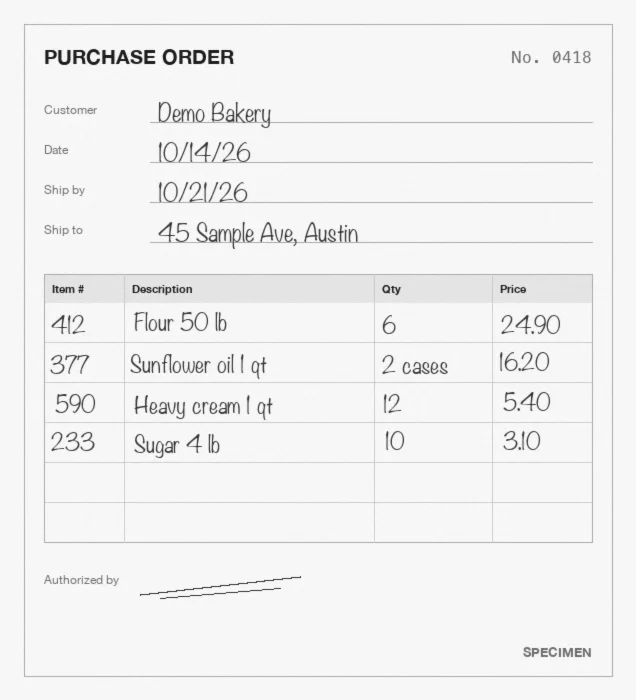
What does a purchase order look like? A specimen, read line by line
Here is a specimen PO, invented for this guide, from a group of dental clinics to a medical supplies distributor. The figures are real arithmetic: you can check every line.
| Line | Item code | Description | Qty | UoM | Unit price | Amount |
|---|---|---|---|---|---|---|
| 1 | NG-100-M | Nitrile gloves, size M, box of 100 | 40 | box | 7.85 | 314.00 |
| 2 | SY-3ML | Syringes 3 ml, box of 100 | 12 | box | 11.40 | 136.80 |
| 3 | GZ-4X4 | Gauze sponges 4 x 4, pack of 200 | 25 | pack | 6.20 | 155.00 |
| 4 | DW-160 | Disinfectant wipes, canister of 160 | 30 | each | 5.95 | 178.50 |
| Subtotal | 784.30 | |||||
| Shipping | 18.00 | |||||
| Sales tax 8.25 % on goods | 64.70 | |||||
| Total | 867.00 |
How to read it. Each line amount is quantity times unit price: 40 × 7.85 = 314.00, 12 × 11.40 = 136.80, 25 × 6.20 = 155.00, 30 × 5.95 = 178.50. The subtotal is the sum of the lines, 784.30. Tax here applies to goods only, 784.30 × 8.25 % = 64.70 after rounding, and shipping is added untaxed, for a total of 867.00. Whether shipping is taxed depends on the state and on how it is billed; the PO should say which rule it follows, because the invoice will be compared with it.
Now the questions each person asks of this document. The supplier asks: do we stock NG-100-M in size M, and can we ship 40 boxes by 12 November? The receiving clerk asks: did 40 boxes of gloves come in, or 38? AP asks, when the invoice arrives: is the glove price still 7.85, is the quantity invoiced no more than the quantity received, and does the total still add up? A PO that is vague on the unit ("gloves x 40") or missing a line number makes each of those answers slower.
Is a purchase order legally binding?
In most cases, a PO is an offer to buy. It becomes a binding contract when the supplier accepts it: by signing an acknowledgment, by confirming in writing, or simply by shipping. In the United States, sales of goods between businesses fall under Article 2 of the Uniform Commercial Code (UCC). Section 2-206 says an order for prompt shipment can be accepted either by a prompt promise to ship or by the shipment itself. Section 2-201 says that a contract for the sale of goods of $500 or more is generally not enforceable without a signed writing, which is one reason companies keep POs and their confirmations.
Three practical consequences. First, the supplier's order confirmation can add or change terms; read it, and compare it with the PO, rather than filing it. Second, a PO can be cancelled or changed before acceptance, but after acceptance a change is a new agreement, usually issued as a PO revision with the same number and a version suffix. Third, the rules differ outside the US and for services; this is general information, not legal advice.
The four common types of purchase orders
Most procurement guides and ERPs use the same four types. They differ on what is fixed when the PO is issued: the items, the quantities, the delivery schedule, or only the terms.
| Type | Items and price | Quantity | Delivery dates | Typical use |
|---|---|---|---|---|
| Standard PO | Fixed | Fixed | Fixed | One off purchase: 40 boxes of gloves, delivered on 12 November |
| Planned PO | Fixed | Fixed (total) | Estimated, released later | Known need over a period, delivered in scheduled releases |
| Blanket PO | Fixed or capped | Open, up to a value or volume ceiling | Open | Repeat purchases from one supplier over a year, called off as needed |
| Contract PO | Terms only | None | None | Framework agreement; separate standard POs reference it |
For someone reading documents, the type changes what a match looks like. A blanket PO is consumed by many deliveries and many invoices, so each invoice is checked against the remaining balance, not against the full order.
Purchase order, invoice, receipt: which document does what
The PO is one of five or six documents in a purchase. People search for the difference between a purchase order and an invoice more than for any other pair, but the confusion usually covers the whole chain, starting upstream with the PR and PO: the request to buy comes before the order itself.
| Document | Sent by | When | What it says |
|---|---|---|---|
| Purchase requisition | Requester, internally | Before the PO | We need this; please approve |
| Purchase order | Buyer to supplier | Before delivery | We will buy this, at this price |
| Order confirmation (acknowledgment) | Supplier to buyer | After the PO | We accept, with these dates (and sometimes changes) |
| Sales order | Supplier, internally | After the PO | The supplier's own record of the same order, in its ERP |
| Delivery note and goods receipt | Supplier, then receiving | At delivery | This is what shipped; this is what we counted |
| Invoice | Supplier to buyer | After delivery | Pay this amount by this date |
So a PO is not a payment, and it is not a bill. The invoice is the request for payment; the PO is what that request is checked against. On the supplier side, the incoming PO is keyed, or read automatically, into a sales order: that step is what sales order automation is about.
What happens to a PO after it is sent
A PO stays open until every line is received and invoiced, or until someone closes the balance. In between, it is read at least three times: by the supplier's order desk, by the buyer's receiving team, and by AP. Each read is a chance to rekey a number wrongly. On a PO with 30 lines, the line items are where the errors sit, not the header.
Whether you send POs or receive them, the reading step can be automated. Koncile, the company behind this site, reads purchase orders in PDF, scan, photo, fax or handwritten form and returns the header and each line as separate fields (item code, description, quantity, unit, unit price, amount), with a confidence score on each value, totals recomputed from the lines and lines matched to your item catalog. It does not create POs, approve them or pay invoices. Developers can call the purchase order OCR API directly; an account comes with 20 free credits.
Frequently asked questions
01What is a purchase order in simple terms?
A document a buyer sends to a supplier to order goods or services. It lists the items, quantities, prices, delivery address and date, and payment terms, and carries a PO number that the supplier will quote on the delivery note and the invoice.
02What does PO stand for?
Purchase order. The PO number is the unique reference the buyer gives each order.
03How does a purchase order work?
The buyer approves a need, writes the PO and sends it. The supplier accepts it, ships the goods and invoices against the PO number. The buyer records the receipt, then checks the invoice against the PO and the receipt before paying.
04Is a purchase order the same as payment?
No. A PO is a commitment to buy, not a payment and not a bill. Payment is made later, against the supplier's invoice, on the terms written in the PO (for example Net 30).
05What is the difference between a bill and a purchase order?
The buyer issues the PO before delivery to say what it will buy. The supplier issues the bill, or invoice, after delivery to ask to be paid. The bill should match the PO on items and prices, and the receipt on quantities.
06Is a purchase order legally binding?
Usually once the supplier accepts it, by confirming or by shipping. In the US, sales of goods follow Article 2 of the Uniform Commercial Code; other countries have their own rules. Before acceptance, the buyer can normally withdraw or change it.
07Who creates a purchase order?
The buyer: a purchasing team in larger companies, or the person who orders in a small business, often after a manager approves a purchase requisition. The supplier never issues the buyer's PO; it issues an order confirmation and a sales order on its side.
08Does every purchase need a PO?
No. Many companies set a threshold below which no PO is needed, and pay small or recurring costs such as utilities or subscriptions directly from the invoice. Above the threshold, a PO is what lets AP check the invoice.
Sources
- UCC § 2-206, Offer and acceptance in formation of contract, Legal Information Institute, Cornell Law School (read on 4 November 2026).
- UCC § 2-201, Formal requirements; statute of frauds, Legal Information Institute, Cornell Law School (read on 4 November 2026).
- Purchase order, MIT Procurement: an example of how a university issues and changes POs (read on 4 November 2026).
- Koncile API documentation: format of the extraction response.
See your own POs come back line by line
Upload a purchase order, in any layout, and get the header and every line as fields you can export. No card, no call.
Create a Koncile account, 20 free creditsTalk to an expert
20 free credits, no credit card. For professional use only.