
What is a blanket purchase order? How it works, with a real example
A blanket purchase order is a single PO that covers repeated purchases from one supplier over a set period, at fixed prices and up to a ceiling. Each actual order is a release against it, and each invoice has to fit both the agreed price and the remaining balance. Below: the fields, the process, blanket PO vs standard PO, and a worked example where an invoice breaks the ceiling.
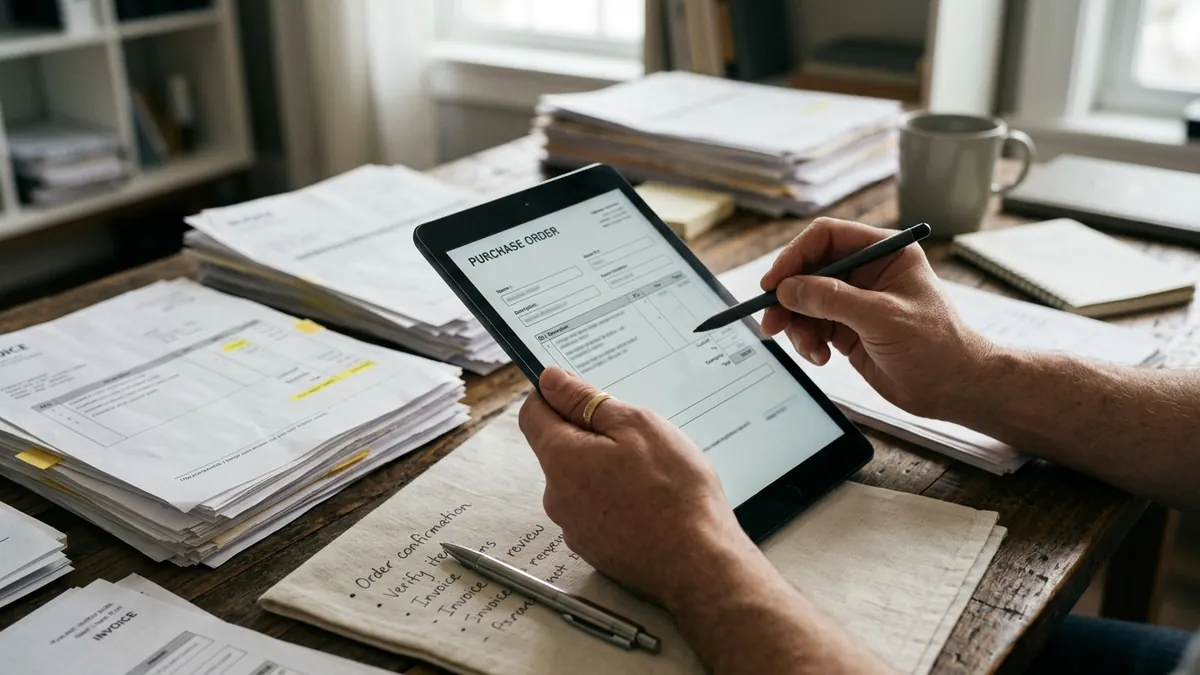
What is a blanket purchase order?
A blanket purchase order (blanket PO, sometimes BPO) is one purchase order that covers many deliveries from the same supplier over a fixed period, usually up to a year. Instead of raising a new purchase order every time the clinic runs out of gloves, the buyer agrees once on the items, the unit prices, a spending ceiling and an end date. Each later order is a short "release" (also called a call-off) against that blanket PO.
So what is a blanket purchase order in plain terms? A pre-approved budget with one supplier, at fixed prices, that is spent down release by release. Nothing is shipped when the blanket PO is signed. Goods move, and invoices arrive, only when a release is sent.
The blanket purchase order meaning is the same across industries, but the name changes with the software. SAP calls the closest objects contracts and scheduling agreements (both "outline agreements"), Microsoft Dynamics 365 calls it a purchase agreement, Oracle uses blanket purchase agreement and blanket release, and in US federal buying the equivalent is a blanket purchase agreement (BPA) under FAR 13.303. Some people simply say blanket order, standing order or open PO.
What a blanket PO contains
A blanket PO is shorter than people expect, because quantities and dates are left open. What it fixes is the frame each release has to fit in.
| Field | Example | What it controls |
|---|---|---|
| Blanket PO number | BPO-NDC-2026-07 | Every release and invoice must quote it |
| Validity period | 1 Jan 2026 to 31 Dec 2026 | Releases outside the dates are refused |
| Items or category | Nitrile gloves, disinfectant wipes | What may be ordered under it |
| Unit prices | $7.85 a box, $5.95 a canister | The price every invoice line is checked against |
| Ceiling (not to exceed amount) | $18,000.00 before tax | Total spend allowed across all releases |
| Release rules | Minimum $500, approver for releases above $5,000 | Who may call off, and how much at once |
| Terms | Net 30, delivery within 5 working days | Payment and service level for every release |
Some blanket POs fix a quantity ("up to 2,000 boxes") rather than an amount. Microsoft documents four variants for Dynamics 365 purchase agreements: a quantity of a product, an amount of a product, an amount within a procurement category, or an amount across any product. The logic is the same: a cap, consumed over time.
How a blanket purchase order works, step by step
- Negotiate the frame. Purchasing agrees prices, ceiling, dates and terms with the supplier, often after a quote or a tender. Many organizations require a competitive bid above a threshold: UC Berkeley, for example, caps blanket POs at $99,999.99 a year without a bid.
- Approve and issue the blanket PO once. The budget is committed at this point, which is where most of the time saving comes from: no approval cycle for each small order.
- Send releases as needs arise. A release names the blanket PO, the items, the quantities and the delivery date. It does not renegotiate anything.
- Receive and record each delivery. Each delivery gets its own goods received note, tied to the release.
- Match each invoice to its release and to the remaining balance. The supplier invoices per release. AP checks the price against the blanket PO, the quantity against the receipt, and the cumulative amount against the ceiling.
- Close or renew. At the end date, unused balance is released from the budget. The buyer reviews volumes and prices before signing the next one.
Steps 3 to 5 repeat many times on one blanket PO. That is the whole point, and also where the errors pile up, because nobody looks at the full picture again until the ceiling is hit.
Blanket PO vs standard PO
The blanket po question that comes up most is when to use one instead of a standard purchase order. The short answer: a standard PO is for a one-off purchase you can describe fully today; a blanket PO is for repeat purchases you can price today but not yet schedule.
| Standard PO | Blanket PO | Contract or framework agreement | |
|---|---|---|---|
| Deliveries | One, or a few on fixed dates | Many, dates unknown | None by itself |
| Quantities | Fixed | Open, within a cap | Usually open |
| Prices | Fixed for this order | Fixed for the period | Fixed or indexed |
| Approval | Each order | Once, then releases | Once, then POs or releases |
| Invoice checked against | The PO lines | The release and the remaining balance | The PO raised under it |
| Typical use | Equipment, a one-time project | Consumables, maintenance, office supplies | Multi-year supply, legal terms |
A blanket PO is not quite a contract. In many companies the legal terms sit in a master agreement and the blanket PO is the financial instrument that sits under it. In others the blanket PO carries the terms itself. Ask your legal team which one is binding before changing a price mid-year.
A worked example: drawing down a blanket PO
Take Northfield Dental Clinics, the buyer used across our guides. In January 2026 it signed BPO-NDC-2026-07 with Brightline Medical Supply for gloves and disinfectant wipes, valid for the calendar year, with a ceiling of $18,000.00 before tax and fixed prices of $7.85 per box of gloves and $5.95 per canister of wipes. Three releases went through without trouble.
| Release | Date | Gloves (box) | Wipes (each) | Release value | Spent to date | Remaining |
|---|---|---|---|---|---|---|
| REL-01 | 10 Feb 2026 | 400 | 200 | 4,330.00 | 4,330.00 | 13,670.00 |
| REL-02 | 12 May 2026 | 600 | 300 | 6,495.00 | 10,825.00 | 7,175.00 |
| REL-03 | 8 Sep 2026 | 500 | 250 | 5,412.50 | 16,237.50 | 1,762.50 |
In November, a fourth release asks for 220 boxes of gloves. At the agreed price that is 220 × $7.85 = $1,727.00, which fits in the $1,762.50 left. The invoice that comes back bills the gloves at $8.10 a box: 220 × $8.10 = $1,782.00.
Two problems, and a standard PO check would only catch one of them. The price is $0.25 a box above the blanket PO, so $55.00 too much on this invoice. And at the billed price, the invoice would take the blanket PO $19.50 over its ceiling. If AP only compares the invoice with the release, the price gap is visible but the ceiling breach is not. If it only looks at the invoice total, nothing looks wrong at all. The right answer here is to pay $1,727.00, ask Brightline for a credit note for the $55.00, and leave $35.50 on the blanket PO until it expires.
This is the same three way matching logic as for any PO (order, receipt, invoice), with one more line in the check: the cumulative amount.
Benefits and risks of a blanket PO
The benefits are real but mostly administrative. Fewer approvals, fewer documents for the buyer to raise, prices locked for the year, and a supplier that can plan its stock. Amazon Business, Ramp and GEP all list the same core advantages in their guides.
The risks are the ones the example shows, and they are less often written down:
- Price drift. Invoices quietly move away from the agreed unit price, a few cents at a time, because each one is small.
- Ceiling breach. Nobody adds up the releases until the budget is gone, or exceeded.
- Releases outside the dates. An order placed in January against last year's expired blanket PO, at last year's prices.
- Wrong reference. An invoice that quotes the blanket PO number but not the release, so AP cannot tell which delivery it pays for.
- Maverick buying. Items not covered by the blanket PO slipped onto a release because the reference was handy.
None of these is a reason to avoid blanket POs. They are a reason to check every invoice against the frame, not just against the release.
When to use one, and when not to
Use a blanket PO when the need is recurring, the supplier is reliable and the price can be fixed for the period: consumables, spare parts, cleaning, office supplies, maintenance visits. Avoid it when prices move fast (raw materials, energy), when demand is too uncertain to set a ceiling you will not blow through, or for one-off capital purchases, where a standard PO gives a cleaner audit trail. The full lifecycle of each order type is in our purchase order process guide.
Reading blanket PO invoices automatically
The hard part of a blanket PO is not the paperwork at signing. It is the stream of releases, delivery notes and invoices that follow, often as PDFs or scans in a shared inbox, each of which has to be tied back to the right blanket PO and checked line by line.
Koncile, the company behind this site, reads that paperwork. It returns the header and every line of a purchase order, a release, a delivery note or an invoice (PDF, scan, fax or photo), including the PO and release references, item codes, quantities and unit prices, and recomputes invoice totals. Koncile does not create or approve purchase orders and does not hold the remaining balance of a blanket PO: that stays in your ERP or procurement tool. Depending on your setup, the extracted lines can be compared with the agreed prices before an invoice is posted. Tightly handwritten corrections and low resolution scans remain the first sources of error, so flagged lines are worth a human look.
Frequently asked questions
01What is a blanket PO in purchasing?
A purchase order that covers repeated purchases from one supplier over a set period, at fixed prices and up to a ceiling. Individual orders are placed as releases against it, without a new approval each time.
02What is the difference between a blanket PO and a standard PO?
A standard PO describes one purchase in full: items, quantities, delivery date and price. A blanket PO fixes the items, prices and a maximum amount, and leaves quantities and dates to the releases sent during the period.
03What is the difference between a purchase order and a purchase agreement?
A purchase agreement sets terms for future purchases (prices, ceiling, duration) without ordering anything. A purchase order is an actual order. A blanket PO sits in between: it is issued as a PO, but goods are only called off through releases.
04What are the four types of purchase orders?
Standard, planned, blanket and contract purchase orders. Standard and planned POs order specific goods; a blanket PO sets prices and a cap for repeat orders; a contract PO only sets terms, with standard POs raised under it.
05How long does a blanket purchase order last?
Usually up to 12 months, often aligned with the financial year. Longer periods are possible but many organizations, universities and public bodies in particular, require a competitive bid for multi-year blanket POs.
06What happens if a blanket PO runs out of money?
Further releases are blocked, or should be. The buyer either raises the ceiling through a change order, with the same approval as the original, or issues a new blanket PO. Invoices above the remaining balance should be held, not paid.
07Is a blanket purchase order the same as a blanket purchase agreement?
Close, but not always. In US federal procurement, a blanket purchase agreement (BPA, FAR 13.303) is a charge account with a qualified supplier, and calls are placed under it. In private companies the two terms are often used interchangeably.
08Do you need a goods received note for each release?
Yes. Each delivery under a blanket PO is received and recorded separately, so each invoice can be matched to what actually arrived for that release.
Sources
- Purchase agreements, Dynamics 365 Supply Chain Management documentation, Microsoft Learn (read on 9 November 2026): commitment types, "Max is enforced" and fixed price policies, fulfillment of a commitment by several purchase orders.
- FAR 13.303-1 General, Federal Acquisition Regulation, Acquisition.gov (FAC 2026-01, read on 9 November 2026): definition of a blanket purchase agreement.
- Blanket Purchase Orders, Supply Chain Management, University of California, Berkeley (read on 9 November 2026): one year limit and $99,999.99 bid threshold.
Check every release against the blanket PO
Upload a purchase order, a release or an invoice and get every line back as fields, prices and references included. No card, no call.
Create a Koncile account, 20 free creditsTalk to an expert
20 free credits, no credit card. For professional use only.