
What is a PO number? Meaning, formats and where it goes
A PO number (purchase order number) is the unique reference a buyer gives each purchase order. The buyer assigns it when the order is issued; the supplier then quotes it on the confirmation, the delivery note and the invoice, so every document can be traced back to one order. Below: what the letters mean, six common formats with examples, where the number goes on an invoice, and five ways it comes back wrong.
What is a PO number?
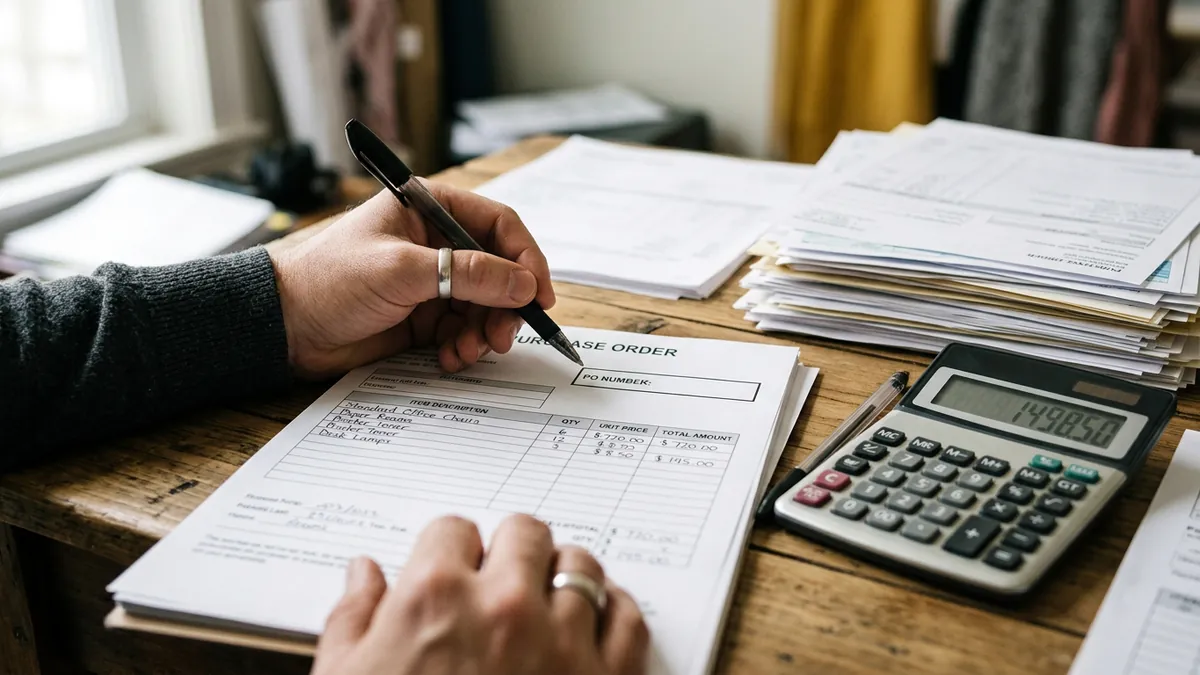
A PO number (purchase order number) is the reference a buyer gives one purchase order so that everyone involved can find it again. It is printed in the header of the PO, usually top right next to the date, and it is unique inside the buyer's company: no two open orders share it.
The number itself carries no value. What matters is where it travels. The supplier quotes it on the order confirmation, the packing slip and the invoice. The buyer's warehouse quotes it when it records the delivery. Accounts payable (AP) uses it to pull up the order before paying. A PO number is, in practice, the key that ties a whole purchase together across two companies that each keep their own records.
If you need the order document itself explained, field by field, our guide on what is a purchase order covers it with a worked example. This page is about the number only: what it looks like, who assigns it, where it goes and what happens when it is missing or wrong.
PO number meaning: what the letters stand for
PO stands for purchase order. On a form you will see it written PO, P.O., PO No., PO #, Purchase Order No. or Order Ref. They all mean the same field. On an invoice, the label "PO number" or "Your ref" means the buyer's order number, not the supplier's own reference.
Do not confuse it with three neighbours that look alike:
- Invoice number: assigned by the supplier to its bill, after delivery. One PO can lead to several invoices, each with its own number and the same PO number.
- Sales order number or order number: the supplier's internal reference for the same order, created when it accepts the PO (PO vs SO explains how the two relate). Online shops call it the order number. It belongs to the seller, so the buyer's AP team cannot search with it.
- PO box number: a mailbox at a post office. Same two letters, nothing to do with purchasing.
Who provides a PO number, and how do you get one?
The buyer assigns it, never the supplier. It is created at the moment the PO is issued, after the internal request (the purchase requisition) has been approved and before the order goes out, at step 4 of the PO process. In most companies today the number is generated by the ERP or the purchasing software when someone clicks "create PO", from a sequence the finance team configured once. In smaller companies it is still taken from a spreadsheet or a numbered paper pad.
For a supplier, this answers the most common question, "how do I get a PO number?": you ask your customer's purchasing contact or the person who placed the order. Buyers that work with POs commonly hold an invoice that does not quote one, so it is worth asking before you ship, not after.
Where to find a PO number, and how to track it
Where you look depends on which side of the order you are on:
- Buyer: in the purchasing module of your ERP or procurement software, or on the PDF of the PO that went out. If you only hold an invoice or a delivery note, the PO number is usually in its header, labelled "PO number", "Customer PO" or "Your ref".
- Supplier: on the PO you received, often in the subject line of the email that carried it, and on your own order confirmation if you copied it there. Some large buyers list open POs on a supplier portal, where you can search by number.
- Employee who asked for the purchase: look up your approved requisition; once it becomes a PO, most purchasing systems show the PO number next to it. Otherwise, ask the purchasing team.
Tracking a PO number means following the order through its statuses: issued, confirmed by the supplier, partly or fully received, invoiced, paid, closed. The buyer tracks it in its ERP, where the PO stays open until every line has been received and billed. A supplier tracks it from the outside, by quoting the number on every document and, when a payment is late, by asking the buyer's AP team for the status of the invoice filed against that PO number. An invoice quoting a wrong or closed PO number is the most common reason it stalls, as the section on missing or wrong numbers below shows.
Common PO number formats, with examples
There is no universal format for private companies. Each buyer picks a scheme and keeps it. Most fall into one of the patterns below.
| Format | Example | What it encodes | Watch out for |
|---|---|---|---|
| Sequential | PO-00142 | Order in which POs were issued | Leading zeros dropped by suppliers (142) |
| Year and sequence | PO-2026-0418 | Fiscal year, then a counter reset each year | Same counter in two years (0418 in 2025 and 2026) |
| Entity or site prefix | NDC-2026-0418 | Which company or site issued it | Prefix left off the invoice |
| Department or project | PO-FIN-2026-031 | Cost center or project | Long strings retyped with a transposition |
| Plain number | 4500018273 | Nothing; an ERP counter | Ten digits that look like a phone or bank number |
| US federal (PIID) | 13 to 17 characters, no hyphens | Issuing office, fiscal year, instrument type, serial | Hyphens or spaces added by the vendor |
The US federal government is the one large buyer with a written standard. Its Procurement Instrument Identifier (PIID), set by FAR 4.1603, runs from 13 to 17 letters and digits without hyphens, dashes or spaces. Positions 1 to 6 identify the issuing office, positions 7 and 8 are the last two digits of the fiscal year, position 9 is a letter for the type of instrument (P for a purchase order, V once the P series is exhausted), and the last four to eight positions are the agency's serial number. The rule also forbids padding a shorter serial with leading or trailing zeros in any system. Those three details, no separators, a type letter and no padding, are exactly the points where private schemes cause trouble too.
Where does the PO number go on an invoice?
On the invoice, the supplier writes the buyer's PO number in the header, near the invoice number and date, with a clear label such as "PO number" or "Customer PO". If the invoice covers several POs, the number goes on each line instead. It should be copied exactly as the buyer wrote it, prefix and zeros included.
The PO number is not one of the fields tax rules require on an invoice. In the United Kingdom, for example, an invoice must carry its own unique identification number, the supplier's and customer's details, the date, the goods or services and the amounts; the buyer's order number is not on that list. It becomes mandatory only because the buyer says so, in its purchasing terms. That is why the field is so often missing or approximate on the invoices AP receives.
| Document | Issued by | Where the PO number sits | Who relies on it |
|---|---|---|---|
| Purchase order | Buyer | Header, next to the PO date | Supplier, receiving, AP |
| Order confirmation | Supplier | Header, as "your order" or "customer PO" | Buyer's purchasing team |
| Packing slip or delivery note | Supplier | Header or label on the carton | Receiving dock |
| Goods receipt (GRN) | Buyer's warehouse | Header, entered at the dock | AP, for three way matching |
| Invoice | Supplier | Header, or on each line if several POs | AP |
| Remittance advice | Buyer | Next to each invoice paid | Supplier's receivables team |
PO number vs invoice number
They answer two different questions. The PO number says which order this is, and the buyer owns it. The invoice number says which bill this is, and the supplier owns it. A single PO for 40 boxes of gloves delivered in two shipments can produce two invoices, INV-BMS-55102 and INV-BMS-55187, both quoting the same PO NDC-2026-0418. AP uses the PO number to find the order and the invoice number to make sure the same bill is never paid twice.
Both numbers have to be on the invoice. The rest of the comparison, which fields must agree and which may differ, is covered in our guide to purchase order vs invoice.
When the PO number is missing or wrong
A PO number goes wrong in a small number of ways, and each one stops an invoice in AP. Take the specimen order from our purchase order guide, NDC-2026-0418, issued by Northfield Dental Clinics to Brightline Medical Supply for $867.00. Here is how that same number can come back on five invented but typical invoices, and what a strict exact match does with each.
| Written on the invoice | What happened | Exact match | What AP does |
|---|---|---|---|
| NDC-2026-0418 | Copied correctly | Found | Checks lines and pays |
| NDC20260418 | Hyphens removed by the supplier's system | Not found | Searches by hand, finds it |
| 0418 | Prefix and year left off | Not found, or wrong PO if 0418 exists in 2025 | Asks the supplier |
| NDC-2026-0481 | Two digits swapped when retyped | Not found, or a different order | Holds the invoice |
| (blank), "see attached" | No PO number at all | Not found | Returns it, or routes it as a non PO invoice |
Only the first case passes without a person. The second and third are recoverable with simple rules that most matching tools apply before comparing: remove spaces, hyphens and the "PO" label, compare without leading zeros, then confirm with a second field such as the supplier and the total. The fourth is the dangerous one. A transposed number that happens to exist sends the invoice to the wrong order, and if that order still has budget, the check passes on the wrong data. A second field is what catches it: in this example, PO NDC-2026-0481 belongs to another supplier.
Once the right PO is found, the real comparison starts: quantities against the goods receipt, unit prices against the PO, line by line. That step is what PO matching software does, and it only works when the number on the invoice has been read correctly in the first place.
How to set up a PO numbering scheme that survives
If you are the buyer, the format you choose decides how many invoices your team will have to search for by hand. Five rules cover most of it:
- Make it unique for ever, not only within a year. A year in the number (2026) or a counter that never resets avoids two open orders sharing 0418.
- Keep it short. Ten to fourteen characters is enough. Every extra character is a chance for a supplier to retype it wrong.
- Pick one separator, or none. If suppliers drop hyphens, match without them. The US federal PIID simply bans them.
- Avoid letters that look like digits: O and 0, I and 1, S and 5, B and 8. Scanners and people confuse them, especially on faxed or handwritten POs.
- Say it in your terms: no PO number, no payment, with the exact format expected. Suppliers follow rules they can read.
Reading PO numbers from documents automatically
Every step above assumes the PO number exists as data on both sides. When POs, delivery notes and invoices arrive as PDFs, scans or photos, someone has to read the number off each one first, and most of the errors in the table come from that retyping: a dropped prefix, two swapped digits, a 0 read as an O.
Koncile, the company behind this site, reads purchase orders, delivery notes and invoices and returns the PO number as its own field, next to the header and each line item (item code, description, quantity, unit, unit price, amount), with a confidence score on each value. It reads the number as printed; how strictly your system then compares it, with or without separators, depends on your setup. It does not create POs, approve spending or pay invoices. Accuracy drops on dense handwriting, low resolution scans and skewed photos, which is where a PO number is most often misread, so low confidence values are best shown to a person rather than accepted.
Frequently asked questions
01What is a PO number?
A unique reference the buyer gives each purchase order. The supplier quotes it on the confirmation, delivery note and invoice so the buyer can match every document to the order.
02What does PO number stand for on an invoice?
Purchase order number: the buyer's reference for the order the invoice bills. It is not the invoice number, which the supplier assigns to the bill itself.
03Where do I find a PO number?
On the purchase order header, usually near the date. As a supplier, ask the person who placed the order or your customer's purchasing team; it is also on any order confirmation you sent.
04How do I track a PO number?
Buyers track it in their ERP or purchasing software, where the PO shows as issued, received, invoiced or closed. Suppliers track it on the buyer's supplier portal when there is one, or by asking the buyer's AP team for the status of the invoice that quotes it.
05Can a PO number have letters in it?
Yes. Many schemes add a prefix for the company, site or department, such as NDC-2026-0418. The US federal PIID mixes letters and digits but bans hyphens and spaces.
06Is a PO number the same as an order number?
Not always. The PO number is the buyer's reference. An order number or sales order number is usually the seller's own reference for the same order.
07Who creates the PO number, the buyer or the seller?
The buyer, when it issues the purchase order, usually from a sequence in its ERP or purchasing software. The seller only copies it onto its documents.
08Is a PO number required on an invoice?
Not by tax law in most countries, but often by the buyer's purchasing terms. Buyers that require POs often hold or return invoices that do not quote a valid one.
09Can two purchase orders have the same PO number?
They should not. Duplicates usually come from a counter reset each year without the year in the number, and they send invoices to the wrong order.
Sources
- FAR 4.1603, Procedures (Procurement Instrument Identifier), Federal Acquisition Regulation, Acquisition.gov (read on 6 November 2026).
- Invoicing and taking payment from customers: what invoices must include, GOV.UK (read on 5 November 2026).
- Koncile API documentation: format of the extraction response.
Read the PO number off any document
Upload a purchase order or an invoice and get the PO number, the header and every line back as fields. No card, no call.
Create a Koncile account, 20 free creditsTalk to an expert
20 free credits, no credit card. For professional use only.