
Purchase requisition vs purchase order: PR and PO differences, with an example
A purchase requisition (PR) is an internal request to buy; a purchase order (PO) is the order sent to the supplier once that request is approved. The PR asks for permission with estimated prices, the PO commits the company to agreed ones. Below: the differences side by side, how one becomes the other, and a real example where the two disagree.
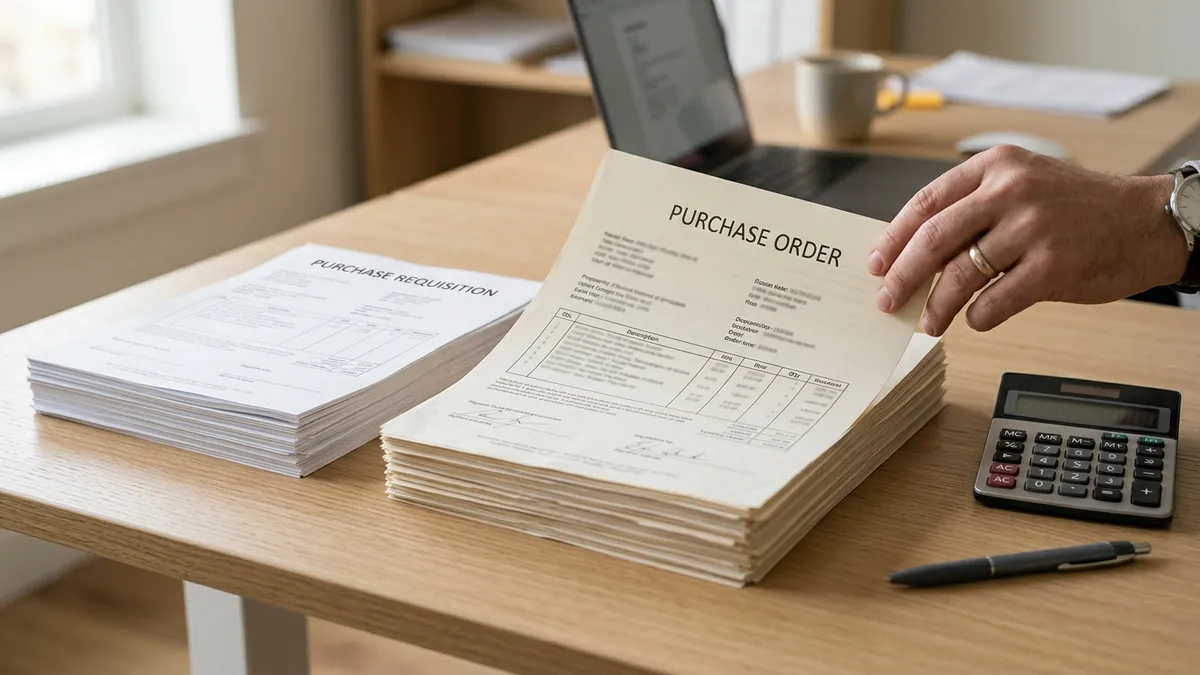
PR and PO: the short answer
A purchase requisition (PR) is an internal request to spend money. An employee or a department fills it in and sends it to a manager, a budget owner or the purchasing team. Nothing is ordered at that point, no supplier is committed and nothing is legally binding.
A purchase order (PO) is the external document the buyer sends to a supplier once the request is approved. It names the supplier, the items, the agreed prices and the terms. Once the supplier accepts it, it commits the company to pay for what is delivered.
So the PR and PO are two steps of the same purchase, in a fixed order: the requisition asks, the order buys. The table below sets out the differences that matter in practice.
| Purchase requisition (PR) | Purchase order (PO) | |
|---|---|---|
| Who creates it | The requester: an employee or a department | Purchasing, or the person allowed to buy |
| Who reads it | Managers, budget owners, finance, purchasing | The supplier, then receiving and accounts payable |
| Direction | Internal only | Sent outside the company |
| When | Before any supplier is chosen or contacted | After the requisition is approved |
| Prices | Estimated (catalog, last price, quote) | Agreed with the supplier |
| Supplier | Optional, often only a suggestion | Required |
| Legal effect | None: it can be rejected or changed freely | Binding once the supplier accepts it |
| Accounting | Not posted; at most an amount reserved on the budget | Recorded as a commitment; later matched to the invoice |
| Number quoted on the invoice | Never | Always: the PO number |
What a purchase requisition contains
A requisition only needs enough detail for someone to say yes or no, and to find the request again later if the purchase is questioned. Zoho's procurement guide lists the usual fields: requester and department, date, a requisition number, the reason for the purchase, items and quantities, the requested delivery date, the expected price and, if known, a vendor. Most companies add a budget or cost center code so the approver can see what the money comes out of.
What is missing matters as much. A requisition has no binding price, no payment terms, often no supplier, and nothing the supplier has seen. That is why it can never be used to check an invoice.
Not every purchase needs one. Many companies skip the requisition below a threshold and let staff buy on a corporate card or straight from a preferred supplier. Above it, the requisition is the main control point before money is committed: Procurify calls it a permission slip.
How a requisition becomes a purchase order
- The need is raised. A requester fills in the requisition, from a catalog or in free text, with items, quantities and an estimated cost.
- It is reviewed. The approver checks the budget and whether the purchase is needed, and approves, rejects or sends it back. Large amounts go through several levels.
- Purchasing sources it. The buyer picks a supplier, asks for quotes if needed, and confirms prices, dates and terms. Several approved requisitions for the same supplier can be grouped into one order, and one requisition can be split across two suppliers if no single one can deliver everything.
- The PO is created and sent. The approved lines are copied into a purchase order with its own PO number, the agreed prices and the supplier's details, then sent.
- The requisition is closed. It keeps a link to the PO that fulfilled it, for audit, and stops there.
ERPs follow the same pattern with their own names. In Microsoft Dynamics 365, a requisition moves from Draft to In review, then to Approved or Rejected; an approved line is Closed once a purchase order has been generated for it, or Cancelled if the need disappears. Microsoft also documents demand consolidation: approved lines from several requisitions grouped before one order is placed, to get a better price. SAP and Oracle work the same way, with a requisition document converted into a PO once released.
Steps 1 to 5 above are the start of the purchase order process; everything after the PO (confirmation, delivery, invoice) never refers back to the requisition.

A worked example: from requisition to purchase order
Take Northfield Dental Clinics, the buyer used across our guides. On 2 November 2026 the practice manager of one clinic raises requisition PR-2026-1187 for four lines of consumables, with prices taken from the last order. The regional manager approves it on 3 November. On 4 November purchasing turns it into PO NDC-2026-0418, sent to Brightline Medical Supply, the specimen detailed in our guide on what a purchase order is.
| Line | Item | Qty | PR estimate | PR amount | PO price | PO amount |
|---|---|---|---|---|---|---|
| 1 | Nitrile gloves, size M, box of 100 | 40 box | 8.00 | 320.00 | 7.85 | 314.00 |
| 2 | Syringes 3 ml, box of 100 | 12 box | 11.40 | 136.80 | 11.40 | 136.80 |
| 3 | Gauze sponges 4 x 4, pack of 200 | 25 pack | 6.50 | 162.50 | 6.20 | 155.00 |
| 4 | Disinfectant wipes, canister of 160 | 30 each | 5.95 | 178.50 | 5.95 | 178.50 |
| Subtotal | 797.80 | 784.30 |
Three things changed between the two documents. None of them is an error; they are exactly what the step from request to order is for.
- The prices. The requisition estimated $797.80; the agreed prices bring the order to $784.30, $13.50 less. The approval was given on the estimate, so most companies let the PO go through when it lands below, and send it back for approval when it lands above a set tolerance.
- The supplier and terms. The requisition only suggested Brightline. The PO names it, adds Net 30 payment terms, the delivery address, a delivery date of 12 November, shipping ($18.00) and sales tax.
- The reference. PR-2026-1187 stays inside Northfield. Brightline only ever sees NDC-2026-0418, and that is the number its delivery note and its invoice will carry.
When the invoice arrives, accounts payable checks it against the PO and the goods receipt, not the requisition: that is three way matching. If the invoice bills gloves at $8.00, the estimate from the requisition, it is $6.00 above the PO on that line and should be held, even though $8.00 was the figure the manager approved.
Do you always need both?
No. Three common cases skip one of them.
- PO without a requisition. Repeat purchases under a contract, automatic replenishment from stock levels, or a blanket purchase order where each release is covered by an approval given once for the whole frame. The approval happened earlier, once.
- Requisition without a PO. Small purchases paid by card, subscriptions, or a request that is rejected or cancelled. The requisition is closed with no order behind it.
- Neither. Very small companies often order by email and match the invoice to the email. It works until the volume grows, then nobody can say who approved what.
The rule of thumb used by most procurement teams: a requisition when the spend needs someone's permission, a PO when a supplier needs to be bound to a price and a quantity.
Common mistakes that cost money later
- Treating the approved requisition as the order. A supplier who receives an emailed requisition may ship it, at its own list prices, with no PO number to match against.
- Typing the requisition into the PO a second time. Quantities and item codes get keyed twice by hand; a 40 becomes a 400 and nobody sees it until the invoice arrives and the quantities no longer agree with the goods receipt.
- Approving on estimates that are far from the real price. If estimates are routinely 20 % too low, approvals stop meaning anything.
- Invoices quoting the requisition number. It happens when the PR number was shared with the supplier by mistake. The invoice then matches nothing and sits in an exception queue.
Where reading documents automatically fits
The requisition is usually born digital, inside the ERP or a procurement tool, so there is little to read. The paperwork piles up after the PO: order confirmations, delivery notes and invoices that come back as PDFs, scans or photos, each of which has to be tied to the right PO number and checked line by line.
Koncile, the company behind this site, reads those documents. It returns the header and every line of a purchase order, a delivery note or an invoice, including the PO number, item codes, quantities and unit prices, and recomputes invoice totals. It does not create requisitions or purchase orders and does not run approvals: that stays in your ERP or procurement tool. Depending on your setup, the extracted lines can then be compared with the PO before an invoice is posted. Tightly handwritten notes and low resolution scans remain the first sources of error, so flagged lines are worth a human look.
Frequently asked questions
01What is the difference between a purchase requisition and a purchase order?
A purchase requisition is an internal request for permission to buy, sent to a manager or to purchasing. A purchase order is the external document sent to the supplier once that request is approved, with agreed prices and terms. The requisition commits nothing; the PO commits the company once the supplier accepts it.
02Which comes first, a requisition or a purchase order?
The requisition. It is raised and approved first, then purchasing turns it into a purchase order. A PO can exist without a requisition (contract or replenishment purchases), but a requisition never comes after the PO it led to.
03Is a purchase requisition the same as a purchase order?
No. They can list the same items, but the requisition is internal, uses estimated prices and has no legal effect, while the PO goes to the supplier, carries agreed prices and becomes binding once accepted.
04Is a purchase request the same as a purchase requisition?
In most companies, yes: purchase request, purchase requisition and PO request are used for the same internal document. Some ERPs keep a separate, lighter request step before the requisition, but the role is the same.
05Is a purchase requisition legally binding?
No. It is an internal document and can be changed, rejected or cancelled without involving the supplier. The purchase order becomes binding once the supplier accepts it, by confirmation or by delivering.
06What does PR mean in SAP?
PR stands for purchase requisition, the internal document that is released (approved) and then converted into a purchase order. Other ERPs, such as Microsoft Dynamics 365 and Oracle, use the same name.
07Can one purchase order cover several requisitions?
Yes. Purchasing often groups approved lines from several requisitions for the same supplier into one PO to get a better price or one delivery. Microsoft documents this as demand consolidation. The reverse is also possible: one requisition split across several suppliers and POs.
08Which number should appear on the supplier's invoice?
The PO number. The supplier never needs the requisition number, and an invoice that quotes it cannot be matched automatically to an order.
Sources
- Purchase requisition overview, Dynamics 365 Supply Chain Management documentation, Microsoft Learn (read on 10 November 2026): requisition statuses, purchase order generated for an approved line, demand consolidation.
- The key differences between purchase orders and purchase requisition forms, Zoho Procurement Academy (read on 10 November 2026): usual fields of a requisition form, optional requisitions for small purchases.
- What is a purchase requisition and why it is important for your business?, Procurify (updated 4 March 2026, read on 10 November 2026): requisition as an upstream control point, not legally binding.
Check every invoice against the PO, not the estimate
Upload a purchase order, a delivery note or an invoice and get every line back as fields, PO number and prices included. No card, no call.
Create a Koncile account, 20 free creditsTalk to an expert
20 free credits, no credit card. For professional use only.