
What is three way matching in accounts payable? A worked example
Three way matching is the accounts payable check that an invoice bills only what was ordered on the purchase order and what was actually received on the goods receipt, at the agreed price. If the three documents agree within tolerance, the invoice is approved for payment; if not, it is held as an exception. Below: the steps, a worked example with a partial delivery, how it differs from two way and four way matching, and where it breaks in practice.
What is three way matching?
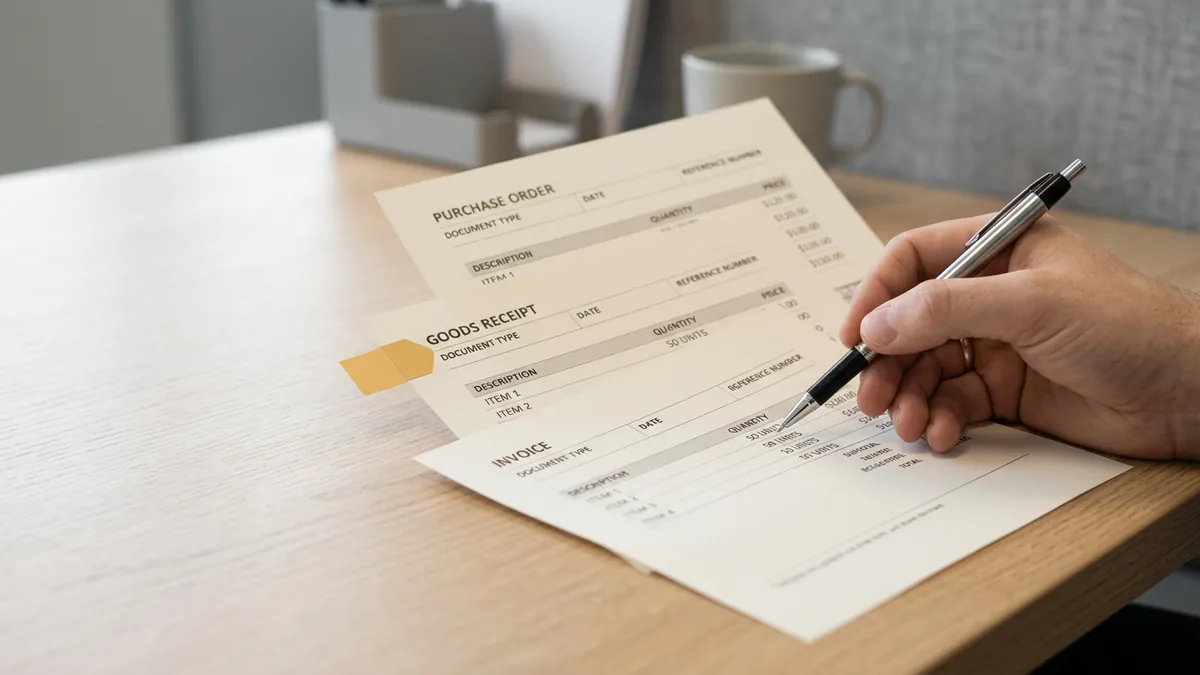
Three way matching is an internal control in accounts payable (AP). Before a supplier invoice is paid, someone, or a system, compares it with two other documents: the purchase order (PO) that authorized the purchase, and the goods receipt (also called goods received note, GRN, or receiving report) that records what arrived. The invoice is paid only for what was ordered, at the ordered price, and only for what was received.
Each document answers a different question. The PO says what the company agreed to buy; in the purchase order definition accountants use, it is a commitment, not yet an expense. The goods receipt says what physically came through the door. The invoice says what the supplier wants to be paid. A mismatch between any two of them is a reason to stop and look.
| Document | Issued by | What it proves | Fields used in the match |
|---|---|---|---|
| Purchase order | The buyer (purchasing) | The purchase was approved, at this price | PO number, vendor, item or SKU, quantity, unit of measure, unit price, line total |
| Goods receipt or delivery note | Receiving or warehouse (or the supplier's delivery note, signed) | The goods arrived, in this quantity | PO number, delivery date, item, quantity received, unit |
| Supplier invoice | The vendor | This is what the vendor bills | Invoice number, PO number, item, quantity billed, unit price, line total, freight, tax, total |
The control exists to stop three kinds of loss: paying for goods that never arrived, paying more than the agreed price, and paying for things nobody ordered. It also catches duplicate invoices and keeps a paper trail that auditors can follow from approval to payment.
How three way matching works, step by step
Whether it is done by a clerk with three printouts or by an ERP, the logic of 3 way matching in accounts payable is the same.
- Find the PO. The invoice must reference a PO number. Without it, the invoice goes back to the vendor or to a person who can identify the order.
- Find the receipts. Pull every goods receipt recorded against that PO. One PO can have several receipts if the goods came in more than one delivery.
- Pair the lines. Each invoice line is paired with a PO line and with the received quantity for that line, usually by item number, sometimes by description.
- Compare price and quantity. Unit price on the invoice against unit price on the PO; quantity billed against quantity received (and not above quantity ordered). Units of measure must be converted first: 2 cases of 12 and 24 pieces are the same quantity.
- Apply tolerances. Small differences inside an agreed tolerance pass. Anything beyond it becomes an exception.
- Approve or hold. Lines that match are approved for payment. Exceptions are held and routed: to purchasing for a price, to receiving for a quantity, to the vendor for a credit note.
The last step matters as much as the comparison. A three way match that only flags problems, without saying who resolves them, turns into a queue of invoices that nobody owns.
A worked example: one PO, a partial delivery and one invoice
Take specimen PO DEMO-204, issued to an industrial supplier for four lines of consumables. The supplier ships part of the order, the receiving clerk records the delivery, and the invoice arrives for the full order plus freight. The company allows a 2 % tolerance on unit price and no tolerance on quantity.
| Line | Ordered (PO) | Received (goods receipt) | Invoiced | Result |
|---|---|---|---|---|
| Nitrile gloves, box of 100 | 20 boxes at 18.50 = 370.00 | 20 boxes | 20 boxes at 18.50 = 370.00 | Match |
| Hex bolts M10, box of 50 | 40 boxes at 12.00 = 480.00 | 30 boxes (10 back ordered) | 40 boxes at 12.00 = 480.00 | 10 boxes billed, not received: 120.00 held |
| Cable ties, pack of 100 | 15 packs at 6.40 = 96.00 | 15 packs | 15 packs at 6.72 = 100.80 | Price +5.0 %, above the 2 % tolerance: 4.80 held |
| Freight | Not on the PO | 45.00 | Charge not ordered: 45.00 held | |
| Total | 946.00 | 826.00 at PO prices | 995.80 | Pay 826.00, hold 169.80 |
Line by line, the check is simple arithmetic. The gloves match on all three documents. On the bolts, the invoice bills 40 boxes but only 30 were received: 10 × 12.00 = $120.00 cannot be paid yet. On the cable ties, the quantity is right but the price went from 6.40 to 6.72, a rise of 0.32, which is 5.0 %. The tolerance is 2 %, so the difference of 15 × 0.32 = $4.80 is held until purchasing confirms or rejects the new price. The freight line is not on the PO at all, so someone has to approve it.
The amount that can be paid today is the value of what was received, at the PO price: 370.00 + 30 × 12.00 + 96.00 = $826.00. The remaining $169.80 (120.00 + 4.80 + 45.00) waits for the back order, a price decision and a freight approval.
Two details are worth noticing. First, a two way match (invoice against PO only) would have passed the bolts line, because the invoice quantity equals the ordered quantity: the company would have paid $120.00 for goods still sitting in the supplier's warehouse. Second, with a 5 % price tolerance instead of 2 %, the cable ties would have passed exactly at the limit. Tolerances decide what reaches a person, so they deserve a real decision, not a default.
Two way, three way and four way matching compared
The question of 2 way and 3 way match comes down to one document: the goods receipt. Two way matching checks that the invoice agrees with the PO; three way matching adds proof of delivery. Some companies add a fourth document, an inspection or quality report, for goods that must pass a test before they are accepted.
| Method | Documents compared | What it catches | Typical use |
|---|---|---|---|
| Invoice totals matching | Invoice total against PO total | Gross overbilling only | Low value, low risk spend |
| Two way matching | Invoice against PO, line by line | Wrong prices, items not ordered, quantities above the order | Services, subscriptions, utilities, where no physical receipt exists |
| Three way matching | Invoice against PO and goods receipt | All of the above, plus goods billed but not received | Physical goods, inventory, materials |
| Four way matching | Three way, plus an inspection or quality report | All of the above, plus goods received but rejected at inspection | Regulated or high value goods: pharma, food, parts with quality control |
ERPs make these choices configurable. Microsoft Dynamics 365 Finance, for example, documents invoice totals matching, two way matching on price and three way matching on price and on the quantity of the selected product receipts, and lets a company set the policy per legal entity, per vendor or per item. A common setup is two way matching for services and three way matching for stock items.
Does the PO have to match the invoice exactly? No. It has to match within the tolerance the company set, and only for the lines that were delivered. Partial invoices, back orders and price changes agreed by email are normal; the control is there to make them visible, not to forbid them.
Tolerances: how much difference is acceptable?
A tolerance is the gap the company accepts without a review. It can be a percentage, an amount, or both, and it can apply to the unit price, the line total or the invoice total. The Microsoft documentation gives a simple case: a 5 % net unit price tolerance on a PO line at 1.00 per unit means an invoice at 1.05 passes and an invoice at 1.10 does not.
- Price tolerance absorbs rounding and small agreed changes. Set too wide, it becomes a silent price increase on every invoice.
- Quantity tolerance is often zero for stock items. Some industries accept a small over delivery (bulk goods sold by weight, for example).
- Amount caps stop a percentage tolerance from hiding large sums on large lines: 2 % of $50,000 is $1,000.
- Header tolerance on the invoice total is the weakest form: two errors in opposite directions cancel out.
Tolerances should be checked line by line. A 2 % gap on the invoice total can hide a 12 % overbilling on one line and an underbilling on another; our invoice matching software page works through exactly that case.
Partial deliveries, early invoices and other real cases
The invoice arrives before the goods
It happens often: the vendor invoices on shipment, the goods arrive three days later. A strict three way match holds the invoice until the receipt is recorded, then releases it. The risk is not the hold, it is forgetting it: held invoices need a date and an owner, or early payment discounts are lost.
One PO, several receipts and several invoices
A PO for 40 boxes may be received in two deliveries and billed in two invoices. Each invoice is matched against the receipts not yet invoiced. The ERP has to track the quantity already billed per line, or the second invoice will look like a match on its own and the line ends up paid twice.
Units of measure and supplier item numbers
The PO counts boxes, the delivery note counts pieces, the invoice counts cases. The supplier prints its own SKU, and your item number is only in the description. Neither is an error, but a matching rule that compares raw numbers will flag every one of these lines. A conversion table for units and a cross reference for item numbers remove most false exceptions.
Services and non stock purchases
There is no warehouse receipt for a consulting day or a software licence. Companies either use two way matching for these purchases or ask the requester to confirm the service in the system, which then acts as the receipt.
Where three way matching breaks: the data, not the rule
The rule fits on one line. What makes it slow is getting the three documents into a state where they can be compared. In many companies the PO lives in the ERP, but the delivery note is a signed paper slip scanned at the dock, and the invoice is a PDF in a shared mailbox. The usual failure points:
- No PO number on the invoice, or a customer reference printed in its place, so the invoice cannot be tied to an order.
- Receipts never entered in the ERP: the goods arrived, the delivery note sits in a tray, and every invoice for that supplier goes on hold.
- Handwritten quantities on delivery notes, crossed out and corrected by the driver, which nobody types in.
- Line items read as one block of text, so the quantity and the unit cannot be compared separately.
- Duplicate invoices sent by email and by post, each matched against the same receipt.
This is why most three way matching projects start with document capture rather than with the matching rule. When the PO, the delivery note and the invoice all come back as structured lines with the PO number, item, quantity, unit and price as separate fields, the comparison itself is the easy part.
Automating three way matching
There are three common setups. The ERP runs the match if POs, receipts and invoices are all entered in it: SAP, Oracle, NetSuite and Dynamics 365 all have matching policies and tolerances. An AP automation suite (Coupa, Tipalti, Medius, BILL and others) adds invoice capture, approval workflows and payment around the match. And an extraction layer reads the documents that still arrive on paper or as PDFs, so the ERP or AP suite receives clean data.
Koncile sits in that third position. It reads purchase orders, delivery notes and invoices with templates from the same library, including scans, faxes and handwritten delivery notes, and returns each line with quantity, unit and price as separate fields, a confidence score on each value, totals recomputed from the lines and lines matched to your item catalog. The PO number ties the three documents together so they can be compared line by line, through the Koncile API, a webhook or an export. An account comes with 20 free credits, one credit per page.
What it does not do, said plainly: Koncile does not create POs, approve invoices or pay them, and it does not check that goods physically arrived; it reads what the receiving clerk wrote. Where the comparison and its tolerances run, in Koncile's control layer or in your ERP after export, depends on your setup. For an overview of extraction tools that read POs, see our purchase order OCR page.
Frequently asked questions
01What is three way matching?
An accounts payable control that compares the supplier invoice with the purchase order and the goods receipt before payment. The invoice is paid only for what was ordered, at the ordered price, and only for what was received, within an agreed tolerance.
02What are the three documents in a three way match?
The purchase order (what was approved), the goods receipt or delivery note (what arrived) and the supplier invoice (what is billed). All three must carry the PO number so they can be tied together.
03What is the difference between 2 way and 3 way matching?
Two way matching compares the invoice with the PO only, so it catches wrong prices and items not ordered. Three way matching adds the goods receipt, so it also catches goods billed but not delivered. Two way is common for services, three way for physical goods.
04What is four way matching?
Three way matching plus an inspection or quality report. The invoice is paid only for goods that were received and accepted, which matters for regulated or high value goods.
05How do you do 3 way matching in accounts payable?
Find the PO referenced on the invoice, pull the receipts recorded against it, pair each invoice line with its PO line and received quantity, compare unit price and quantity after converting units, apply tolerances, then approve the lines that match and route the exceptions to purchasing, receiving or the vendor.
06What is a matching tolerance?
The difference accepted without review, as a percentage, an amount or both, on the unit price, the line total or the invoice total. Tolerances are safer per line and with an amount cap, because a percentage on the total can hide large errors that cancel out.
07What happens when an invoice fails the three way match?
It is held. The lines that match can be approved, and the exceptions go to whoever can resolve them: purchasing for a price change, receiving for a missing receipt, the vendor for a credit note or a corrected invoice.
08Can three way matching be automated?
Yes, in the ERP or an AP suite, as long as POs, receipts and invoices are available as structured data. When some of them arrive as PDFs, scans or handwritten delivery notes, an extraction step reads them line by line first.
Sources
- Accounts payable invoice matching overview, Microsoft Learn, Dynamics 365 Finance (read on 2 November 2026).
- Three way matching policies, Microsoft Learn, Dynamics 365 Finance (read on 2 November 2026).
- Koncile API documentation: format of the extraction response.
Read your POs, delivery notes and invoices line by line
Upload a purchase order, its delivery note and its invoice, and see the lines come back with PO number, quantity, unit and price. No card, no call.
Create a Koncile account, 20 free creditsTalk to an expert
20 free credits, no credit card. For professional use only.