
Sales order vs purchase order: one order seen from both sides
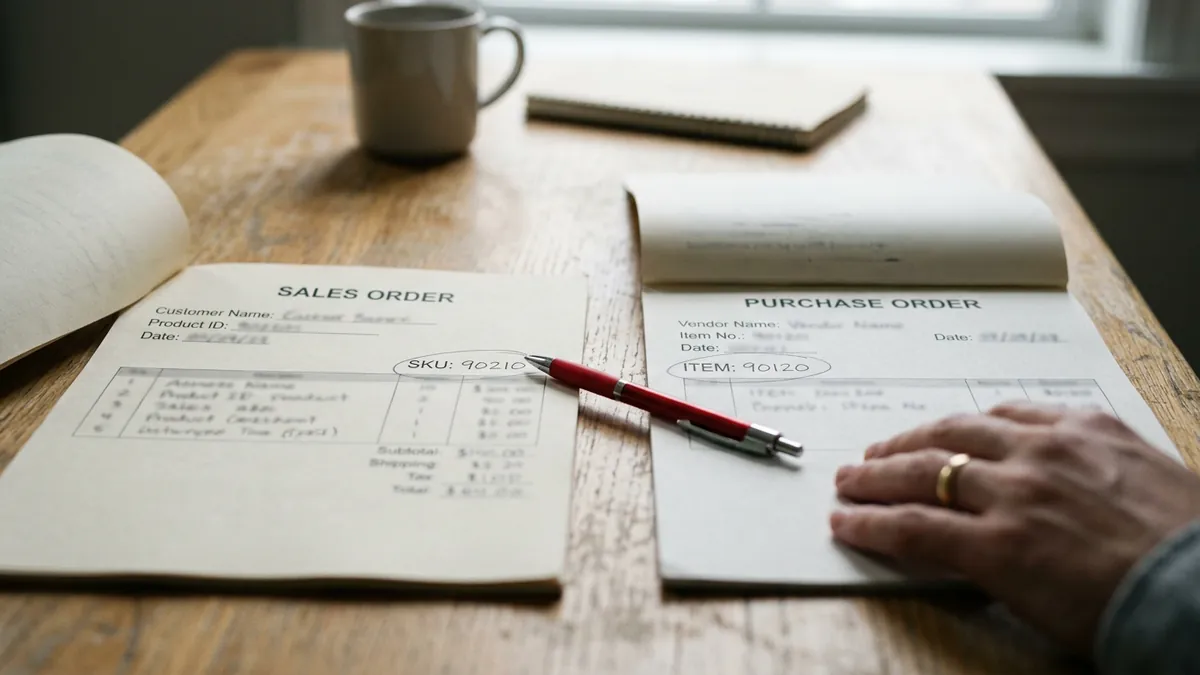
A purchase order (PO) is issued by the buyer to order goods; a sales order (SO) is created by the seller when it accepts that order. Same transaction, two documents, two numbers: the PO comes first and the sales order answers it. Below: the differences side by side, a real order where the two disagree, and the case where a sales order creates a purchase order.
Sales order vs purchase order: the short answer
A purchase order (PO) is written by the buyer. It tells a supplier what the buyer wants, how many, at what price and by when, and once the supplier accepts it, it commits the buyer to pay. It lives on the buyer's side, in purchasing and accounts payable (AP).
A sales order (SO) is written by the seller. It is the seller's own record of the same order, created when the PO is accepted, and it drives everything that happens next in the seller's company: stock reservation, picking, shipping and, at the end, the invoice. It lives on the seller's side, in sales, the warehouse and accounts receivable (AR).
So the purchase order comes first and the sales order answers it. The two usually list the same lines, but they carry different numbers, sit in different systems and are read by different teams. The table below sets out the differences that matter in practice.
| Purchase order (PO) | Sales order (SO) | |
|---|---|---|
| Issued by | The buyer | The seller |
| When | First, to place the order | Second, when the seller accepts the order |
| Purpose | Commit to buy and control spend | Commit to deliver and trigger fulfillment |
| Numbering | Buyer's PO number | Seller's SO number, which quotes the customer PO number |
| Prices | Agreed price, from a quote or contract | Seller's price list or the price on the PO, if they differ someone must decide |
| Who reads it | Purchasing, receiving, accounts payable | Sales, warehouse, shipping, accounts receivable |
| Cycle | Procure to pay | Order to cash |
| Sent to the other party? | Yes, it is the order | Often not; the buyer gets an order confirmation printed from it |
| Checked against | Goods receipt and supplier invoice | Stock, credit limit, and later the shipment and the invoice issued |
Which comes first, the sales order or the purchase order?
In a normal B2B purchase, the purchase order comes first. A quote may come before both, but nothing is committed until the buyer sends a PO and the seller accepts it. The seller then enters that PO into its ERP as a sales order, by hand or with sales order automation, and the SO number is born.
The order is reversed only when the seller works without a PO: walk in or phone orders, web shop orders paid by card, or small customers who never issue purchase orders. The sales order then exists alone, and the field for the customer PO number stays empty. The other exception, where a sales order creates a purchase order, is explained further down.
What each document contains
Both documents describe goods, quantities and prices, which is why they are often confused. The difference is in the fields each party adds for its own work.
- On the purchase order: buyer and supplier names, PO number and date, delivery address and date, line items with item codes, quantity, unit of measure (UoM) and agreed unit price, totals, payment terms, and the instruction to quote the PO number on every invoice. Our guide on what a purchase order is shows a full specimen.
- On the sales order: the seller's SO number, the customer account, the customer PO number as a reference, the seller's own item codes, warehouse and promised ship date per line, the price the seller will invoice, and the order status (open, partly shipped, closed).
- Fields only the SO has are the ones that make the order executable inside the seller's company: stock allocation, carrier, backorder quantity, credit check result. The buyer never needs them, which is why the SO is usually internal.
What the buyer receives back is an order confirmation (also called an order acknowledgment), printed from the sales order. It is the only moment the buyer can see how the seller understood the PO, before anything ships.
A worked example: when the sales order does not match the PO
Take the purchase order from our requisition guide: on 4 November 2026 Northfield Dental Clinics sends PO NDC-2026-0418 to Brightline Medical Supply for four lines of consumables, $784.30 before tax and shipping. Brightline's customer service keys it into its ERP the same afternoon as sales order SO-BMS-55120, and an order confirmation goes back to the clinic.
| Line | Item | PO qty | PO price | PO amount | SO qty | SO price | SO amount |
|---|---|---|---|---|---|---|---|
| 1 | Nitrile gloves, size M, box of 100 | 40 box | 7.85 | 314.00 | 40 box | 8.10 | 324.00 |
| 2 | Syringes 3 ml, box of 100 | 12 box | 11.40 | 136.80 | 12 box | 11.40 | 136.80 |
| 3 | Gauze sponges 4 x 4, pack of 200 | 25 pack | 6.20 | 155.00 | 25 pack, 10 on backorder | 6.20 | 155.00 |
| 4 | Disinfectant wipes, canister of 160 | 30 each | 5.95 | 178.50 | 30 each | 5.95 | 178.50 |
| Total | 784.30 | 794.30 |
Two lines differ, and neither difference is visible unless someone compares the documents line by line.
- The price on line 1. The clinic negotiated gloves at $7.85, but Brightline's ERP priced the line from its standard list at $8.10. The sales order is $10.00 higher than the PO. If nobody notices on the confirmation, the invoice will carry $8.10 too, because invoices are generated from the sales order, not from the customer's PO.
- The split on line 3. Only 15 packs of gauze are in stock; 10 are backordered with a ship date of 18 November. The total does not change, but the clinic will receive two deliveries and possibly two invoices against one PO line.
- Everything else matches: same quantities on lines 2 and 4, same prices, and the PO number NDC-2026-0418 is copied on the SO, so every later document can be traced back to the order.
The cheap moment to fix the price is when the order confirmation arrives: the buyer replies, the seller corrects the SO line to $7.85, and the invoice will be right. If the confirmation is filed unread, the error surfaces weeks later in accounts payable, where the invoice is checked against the PO and the goods receipt in three way matching: line 1 fails on price, the invoice is put on hold, and someone has to ask for a credit note.
When a sales order creates a purchase order
Distributors often sell goods they do not stock. In that case the seller's sales order triggers a purchase order of its own, sent to the manufacturer. This is called a drop ship (or direct ship) when the manufacturer delivers straight to the end customer, and a back to back order when the goods transit through the distributor's warehouse.
The chain then holds three orders for one sale: the customer's PO, the distributor's sales order, and the distributor's PO to the manufacturer. ERPs keep the last two linked. Oracle's JD Edwards documentation, for example, explains that entering a direct ship line on a sales order creates the corresponding purchase order automatically, that cancelling the sales order line cancels the purchase order line, and that receiving the goods updates the sales order status, including for a partial receipt.
For the buyer, nothing changes: its PO is still the reference to quote on the invoice. For the distributor, the margin sits between the price on its sales order and the cost on its own purchase order, and a price change on either side has to be reflected on the other.
Sales order, order confirmation and invoice: how they connect
Three documents come out of the seller's system for one order, and each carries the customer PO number:
- The sales order, internal, created when the PO is accepted.
- The order confirmation, sent to the buyer, which restates the SO lines, prices and promised dates.
- The invoice, issued after shipment, generated from the shipped quantities of the sales order. On the buyer's side it is checked against the PO, as explained in our guide on purchase order vs invoice.
That is why an error made when the PO is keyed into a sales order travels all the way to the invoice: the seller's system never looks at the customer's PO again after that step.
Common mistakes on both sides
- Keying the PO number in the wrong field. If the customer PO number is typed in a free text note instead of the reference field, it does not print on the invoice, and the buyer's AP team cannot match it.
- Pricing from the list instead of the PO. As in the example: the sales order takes the seller's standard price and ignores the contract price written on the PO.
- Ignoring the order confirmation. It is the seller telling the buyer what it understood. Filing it unread moves every difference to the invoice stage, where it costs more to fix.
- Changing the order on one side only. A buyer who emails a quantity change without issuing a revised PO, or a seller who changes a date on the SO without telling the buyer, leaves two documents that no longer agree.
- Confusing the two numbers. The buyer should search by PO number, the seller by SO number. An invoice that quotes only the SO number is hard to match on the buyer's side.
Where reading documents automatically fits
Both sides end up comparing documents that arrive as PDFs, scans or emails. The seller has to turn incoming customer POs into sales orders without retyping them; the buyer has to compare order confirmations and invoices with its own PO, line by line.
Koncile, the company behind this site, reads those documents. It returns the header and every line of a purchase order, an order confirmation or an invoice, including the PO number, item codes, quantities and unit prices, and recomputes invoice totals. It does not create sales orders or purchase orders: your ERP does, from the lines Koncile sends. Depending on your setup, the extracted lines can then be compared with the PO, so that a price like the $8.10 above is flagged before it reaches the invoice. Tightly handwritten orders and low resolution faxes remain the first sources of error, so flagged lines are worth a human look.
Frequently asked questions
01What is the difference between a sales order and a purchase order?
A purchase order is issued by the buyer to order goods or services from a supplier. A sales order is created by the seller when it accepts that order, to organise delivery and invoicing. They describe the same transaction from opposite sides, with different numbers.
02Which comes first, a purchase order or a sales order?
The purchase order. The buyer sends it, then the seller records it as a sales order. A sales order can exist without a PO when the customer does not use purchase orders, for example a card payment on a web shop.
03Is a sales order the same as a purchase order?
No. They can list the same items and quantities, but the PO belongs to the buyer and commits it to pay, while the sales order belongs to the seller and commits it to deliver. Each party keeps its own document and number.
04Is a sales order the same as an order confirmation?
Not exactly. The sales order is the record in the seller's system; the order confirmation is the document sent to the buyer from that record. Many small sellers send the sales order itself as the confirmation.
05Is a sales order legally binding?
The sales order itself is an internal record. What binds the parties is the accepted purchase order, or the order confirmation the seller sends, depending on the terms both sides agreed. When the confirmation differs from the PO, the buyer should answer before goods ship.
06Does the invoice quote the PO number or the sales order number?
Usually both, but the PO number is the one the buyer needs: accounts payable matches the invoice to its PO and goods receipt. An invoice without the customer PO number is often put on hold.
07What is the difference between a sales order and an invoice?
The sales order is created before delivery and confirms what will be shipped. The invoice is issued after shipment and requests payment for what was actually shipped. If an order ships in two parts, one sales order can lead to two invoices.
08Can one purchase order create several sales orders?
Yes. A seller with several warehouses or business units may split one customer PO into several sales orders. The buyer still sees one PO, so every shipment and invoice should quote the same PO number.
Sources
- Understanding integrity between related sales and purchase orders, JD Edwards EnterpriseOne 9.2 documentation, Oracle Help Center (read on 11 November 2026): direct ship sales order lines that create a purchase order, cancellation and receipt updates between the two.
- Sales order vs. purchase order vs. invoice, Zapier (11 September 2023, read on 11 November 2026): the sales order as the seller's document that kicks off fulfillment, after the customer's PO.
- Purchase order vs. sales order: which comes first?, B2BE (26 June 2024, read on 11 November 2026): order of the two documents in a B2B transaction.
Catch the price before it reaches the invoice
Upload a purchase order, an order confirmation or an invoice and get every line back as fields, PO number and prices included. No card, no call.
Create a Koncile account, 20 free creditsTalk to an expert
20 free credits, no credit card. For professional use only.